Long COVID is not one disease. Patients tend to cluster into endotypes, which are subgroups defined by the mechanism that dominates. Each has its own characteristic symptoms and markers and its own treatment implications. Many people overlap more than one endotype.

PACVS. These endotypes were described in Long COVID. Because PACVS shares much of the same biology, the same framework is a reasonable starting hypothesis, but PACVS has not yet been formally endotyped.

The treatment-response evidence below comes from case series, case reports and observational data. None of it is from randomised trials.

Persistence-dominant

Viral RNA or spike antigen persists in tissue reservoirs such as gut epithelium and lymphoid tissue. Symptoms are often gut-predominant and inflammatory markers are elevated.

Hallmark symptoms
  • Relapsing course with viral-like episodes
  • Prominent GI symptoms
Markers
  • Spike antigen or viral RNA in tissue or plasma
  • Elevated inflammatory markers
Treatment signals
  • Antivirals: Improvement reported in case series

Autoimmune-dominant

GPCR autoantibodies against β-adrenergic, muscarinic and angiotensin AT1 receptors, with prominent dysautonomia and relapsing flares. This is the endotype most consistently described in PACVS cohorts.

Hallmark symptoms
  • Orthostatic intolerance
  • Palpitations
  • Anxiety
  • Relapsing flares
Markers
  • GPCR autoantibodies (β-AR, M-AChR, AT1R)
  • IL-6
Treatment signals
  • Apheresis / immunoadsorption: Responses reported in case reports
  • B-cell targeting: Responses reported in case reports

Metabolic / PEM-dominant

Severe, reproducible post-exertional malaise with heavy overlap with ME/CFS. Energy metabolism fails under load.

Hallmark symptoms
  • Post-exertional malaise
  • Exercise intolerance
  • Brain fog
  • Fatigue
Markers
  • Acylcarnitine accumulation
  • Abnormal two-day CPET with a drop in ventilatory threshold
  • Early lactate rise
Treatment signals
  • Pacing. Avoid graded exercise therapy: Graded exercise harms this group

Vascular-dominant

Micro-clot burden, impaired endothelial function, and oxygen desaturation on exertion even though resting tests are normal.

Dominant mechanisms
Hallmark symptoms
  • Breathlessness on exertion
  • Chest tightness
  • Cold extremities
Markers
  • Micro-clot burden
  • Impaired endothelial function
  • Elevated ADMA
  • Low arginine
Treatment signals
  • Anticoagulation: Responses reported in observational data
  • Vasodilators: Responses reported in observational data
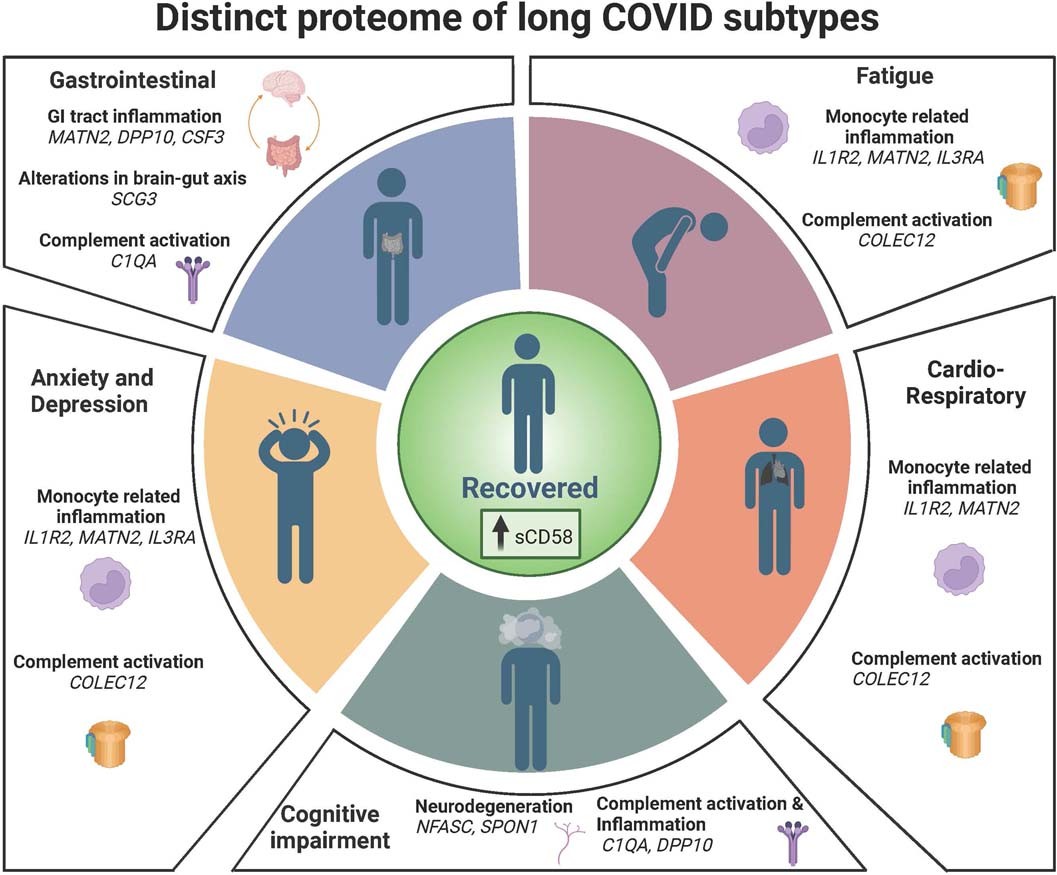
Graphical summary from a large post-hospitalisation cohort (PHOSP-COVID) showing five Long COVID symptom subtypes (gastrointestinal, fatigue, cardio-respiratory, cognitive impairment, anxiety/depression), each with its distinct blood protein signature (e.g. monocyte-related inflammation, complement activation, neurodegeneration markers), compared with recovered patients who showed raised sCD58.
Graphical summary from a large post-hospitalisation cohort (PHOSP-COVID) showing five Long COVID symptom subtypes (gastrointestinal, fatigue, cardio-respiratory, cognitive impairment, anxiety/depression), each with its distinct blood protein signature (e.g. monocyte-related inflammation, complement activation, neurodegeneration markers), compared with recovered patients who showed raised sCD58.Reproduced from Liew et al., Nature Immunology (2024), Extended Data Fig. 10, doi:10.1038/s41590-024-01778-0, CC BY 4.0. Unmodified. Source · CC BY 4.0

Affected body systems

Each organ system shows a characteristic marker signature. ↑ raised, ↓ lowered, + present.

SystemMarker changesClinical pictureMechanisms
Skeletal muscle↑ Acylcarnitines
↓ TCA cycle flux
Post-exertional malaise, exercise intoleranceMitochondria & metabolism, Vascular & clotting
Gut & microbiome↓ Serotonin
↓ Butyrate
Altered bowel habit, bloating, food intolerancePersistent antigen, Immune dysregulation
Blood & coagulation+ Micro-clots
↓ RBC deformability
Exertional breathlessness, cold extremitiesVascular & clotting
Brain & brainstem↑ Kynurenine
↑ Quinolinic acid
Cognitive slowing, unrefreshing sleep, dysautonomiaNeuroinflammation, Immune dysregulation
Heart & endothelium↓ Arginine
↑ ADMA
Palpitations, chest tightness, orthostatic intoleranceVascular & clotting, Autonomic & nerve
Lungs↑ Lactate
↓ Gas exchange
Breathlessness on exertion, air hungerVascular & clotting
Lymphoid tissue+ Spike antigen
+ HERV reactivation
Tender lymph nodes, sore throat, flu-like relapsesPersistent antigen, Immune dysregulation
Liver & bile acids↓ Bile acids
↑ Sphingolipids
Alcohol intolerance, post-prandial fatigueMitochondria & metabolism

What this means in practice

Phenotyping matters

Testing a therapy in an unselected population dilutes any benefit concentrated in one endotype. Studies stratified by endotype are needed.

Exercise is not universally beneficial

Graded exercise therapy harms the metabolic/PEM-dominant group, so activity advice should be tailored to the endotype.

Biomarkers are not yet routine

Diagnosis is still clinical. Specialist metabolomic and immunological assays exist but are not standard care, which is a major gap in translating research into practice.

Mechanisms co-exist

Endotypes often overlap. A common approach is to address the dominant mechanism first, then secondary pathology.

Educational summary only, not medical advice.

Part of the Open Source Medicine Foundation Network

Open Source Medicine Foundation

The central hub for open-source medical research and collaborative science.

Research Platform

Open-access research infrastructure supporting data sharing, methodology, and reproducibility.

SpikeProtein.site

A comprehensive resource on spike protein pathology, persistence, and therapeutic approaches.

Vaccine Data Navigator

Data-driven tools and resources for navigating vaccine safety and efficacy information.

PACVS Research Summit

Consensus-driven PACVS research linking clinicians, scientists, and patient partners.